
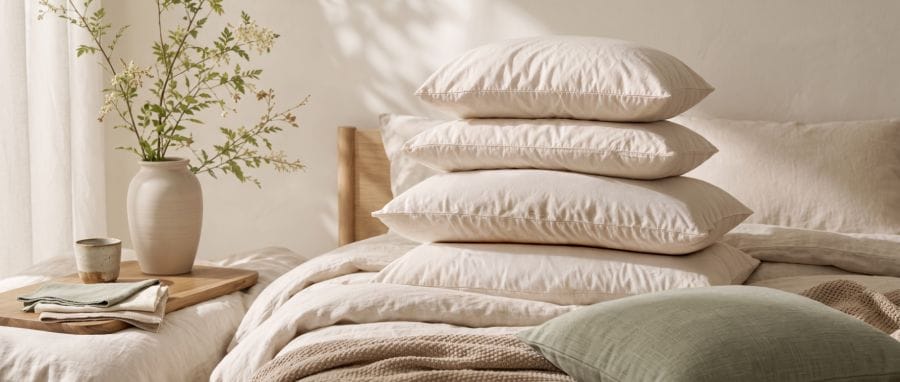
You notice a good pillow mainly because you don’t have to think about it during the night. Your head rests calmly, your neck feels relaxed, and you don’t keep waking up to fluff or reposition the pillow.
But which natural pillow is right for you?
The right choice doesn’t just depend on the filling. Your sleeping position, shoulder width, mattress, desired support, and how warm you get at night all play a role. The difference between a flexible, moldable pillow and a firmer, more shape-retaining pillow is also important.
In this guide, you will read what to look for when choosing a natural pillow and which natural materials best suit different sleep preferences.
Where do you start when choosing a natural pillow?
Start with how you sleep, not with the name of the material.
A side sleeper usually needs more height to fill the space between the shoulder and the head. A back sleeper generally benefits from medium-high support, while a stomach sleeper often lies more comfortably on a lower and more flexible pillow.
Your mattress also plays a part. On a soft mattress, your shoulders and hips sink deeper, meaning you often need less pillow height. On a firmer mattress, your body stays higher.
That’s why there isn’t one single natural pillow that is best for everyone. The right pillow is the one that properly supports the combination of your body, sleeping position, and mattress.
For example, if you have a mattress with a lot of give, a lower pillow might fit better. On a firmer natural mattress, a bit more height can be pleasant.
Which pillow suits your sleeping position?
Side sleeper: choose sufficient height and support
If you sleep on your side, the pillow must fill the space between your head and shoulder. A pillow that is too low can cause your head to sink downwards. A pillow that is too high can push it upwards.
Therefore, look specifically at:
- the height of the pillow;
- the firmness;
- how much the material gives;
- whether you can adjust or shape the pillow.
A specific example within the collection is the wool side sleeper pillow, which is designed for this sleeping position.
Back sleeper: look for calm, medium-high support
On your back, you usually need less height than a side sleeper. The head must be supported without the chin being pushed strongly towards the chest.
A more shape-retaining material can be pleasant here if you don’t want your head to sink deep into the pillow. An ergonomic pillow can also be interesting when you are consciously looking for more structure in the support.
Within the collection, there are, for example, an ergonomic wool pillow and an ergonomic natural latex pillow.
Stomach sleeper: preferably low and flexible
Those who sleep on their stomach usually need less height. A thick or firm pillow can lift the head too far up.
A thinner, flexible natural pillow can then be more comfortable. An example is the thin wool pillow.
Which natural filling suits you?
Natural materials don’t all feel the same. Wool, kapok, natural latex, cotton, hemp, and other natural fillings each have their own character.
Therefore, the question is not only:
“Which material is the most natural?”
but especially:
“Which material suits how I want to sleep?”
Wool: resilient and focused on a pleasant sleep climate
Wool is an interesting choice if you value a natural material that can help regulate heat and moisture.
A wool pillow can absorb moisture without immediately feeling clammy and has a resilient character. This makes wool interesting for people who get warm quickly at night or like to experience a dry and cozy sleep climate.
Various wool variants are available within the collection, including the organic wool pillow, the quilted wool pillow, and the ergonomic wool pillow.
So, even within wool, there is a difference in shape and use.
Kapok: light and airy
Kapok is interesting for those looking for a light and airy natural pillow. The fiber has a flexible character and is often chosen by people who do not want a compact or heavy pillow.
Check out the organic kapok pillow, for example.
Kapok can also be interesting when you are looking for a softer, less shape-retaining feel than with natural latex.
Natural latex: more shape-retaining and supportive
Natural latex has a different character than loose fiber fillings. The material is elastic and more shape-retaining, so the head sinks in less deeply.
This can be pleasant when you like to have a pillow that maintains its shape better and gives a more consistent feel.
Check out the organic natural latex pillow or the ergonomic natural latex variant, for example.
Cotton and hemp: natural fiber alternatives
Cotton and hemp are also represented in the collection. The organic cotton pillow is an option for those specifically looking for cotton. Additionally, there is an organic cotton-and-linen pillow and an organic hemp pillow.
These materials are interesting to consider when you don’t automatically want to choose wool or latex.
How do you choose the right firmness and height?
The right height is at least as important as the filling.
A pillow that is too high can lift your head too far up. A pillow that is too low or too soft can provide insufficient support.
Therefore, pay attention to three things:
1. Your sleeping position
- Side sleeper: usually more height and support.
- Back sleeper: usually medium-high support.
- Stomach sleeper: usually low and flexible.
2. Your shoulder width
The greater the distance between your shoulder and head when you lie on your side, the more height you generally need.
3. Your mattress
A soft mattress lets your body sink deeper. As a result, a lower pillow may be sufficient. On a firmer mattress, more height may be needed.
That’s why it’s wise not to judge a pillow in isolation. Together with your mattress and sleeping position, it forms a single whole.
An adjustable natural pillow can be useful
Are you doubting between different heights? Then a pillow with an adjustable filling can be interesting.
You can then tune the amount of filling to your body and preference. This is especially useful when you are switching from a synthetic pillow to a natural alternative and still need to get used to a different feel.
Not everyone needs a shape-retaining pillow. Some people actually find it pleasant to be able to shape and fluff their pillow a bit during the night.
That difference in preference is important: a pillow that feels too soft for one person may be just right for another.
Which natural pillow for warm sleepers?
If you regularly wake up feeling warm or sweat at night, don’t just look at the thickness of your pillow. The material and the way it handles heat and moisture are also important.
Natural materials can have different properties in terms of ventilation and moisture regulation. Wool, for example, is interesting when you are looking for a material that can absorb moisture and at the same time support a comfortable sleep climate.
An airier natural material such as kapok can also be attractive when you prefer to use a light and less compact pillow.
The same applies to the ticking: the outside of a pillow is also part of the sleep climate.
If heat is a major issue for you, look at the entire pillow, and not just the filling.
Natural doesn’t automatically mean the right pillow
A natural material is no guarantee that a pillow will suit your body.
A wool pillow, for example, can be an excellent fit for someone who likes resilience and a natural sleep climate, but less so for someone who is looking for a very shape-retaining pillow.
Conversely, natural latex can be a good choice for someone looking for more structure, while someone who likes to shape and fluff a pillow might prefer a fiber filling.
The most important questions are therefore:
- How do I sleep?
- How much support do I need?
- Do I want a soft, flexible, or rather a shape-retaining pillow?
- Do I get warm quickly?
- Do I want to be able to shape or adjust the pillow?
- Which natural material appeals to me?
- How important are organic materials and certification to me?
Only then comes the question of which material you choose.
What about allergies and sensitive skin?
When a pillow lies directly against your face, it is understandable that you pay attention to the materials used and the finish.
In doing so, look beyond just the word “natural”. Also pay attention to:
- the composition of the filling;
- the ticking used;
- any certifications;
- the way the pillow can be maintained;
- and whether the material suits your personal sensitivities.
For people specifically looking for a natural pillow due to allergies or sensitivities, it is wise to look at the properties of the individual product instead of assuming that every natural material is the same.
Which natural pillows are available?
NaturaBed has different types of natural pillows, so you don’t have to choose between only “soft” and “firm”.
For those mainly considering wool
For those looking for another natural material
- Organic kapok pillow
- Organic natural latex pillow
- Organic hemp pillow
- Organic cotton pillow
- Organic cotton-and-linen pillow
- Organic spelt pillow
- Organic millet pillow
- Organic horsehair pillow
Choosing a natural pillow: a short checklist
Still in doubt? Go through these questions:
- How do you sleep?
Side, back, or stomach? - How high should your pillow be?
Take your shoulder width and your mattress into account. - How much support do you want?
Soft and moldable or rather firmer and more shape-retaining? - Do you get warm quickly?
Then look extra closely at ventilation, moisture regulation, and the material of the ticking. - Which material suits your preference?
Wool, kapok, natural latex, cotton, hemp, or another natural filling? - Do you want to be able to adjust the pillow?
An adjustable filling can be useful if you are unsure about the right height. - How important are material purity and certification?
Look at the full composition of the product and not just the claim “natural”.
The best natural pillow is the pillow that suits you
Choosing a natural pillow therefore doesn’t start with the question of which material is best. It starts with how you sleep.
A side sleeper needs different support than a stomach sleeper. Someone who gets warm quickly looks at a pillow differently than someone who is primarily looking for shape retention. And someone who likes to be able to shape their pillow has different preferences than someone who wants fixed ergonomic support.
Therefore, first choose the right height, support, and properties. Then choose the natural material that best matches them.
In this way, a natural pillow becomes not just a choice for a beautiful material, but a conscious choice for your way of sleeping.