
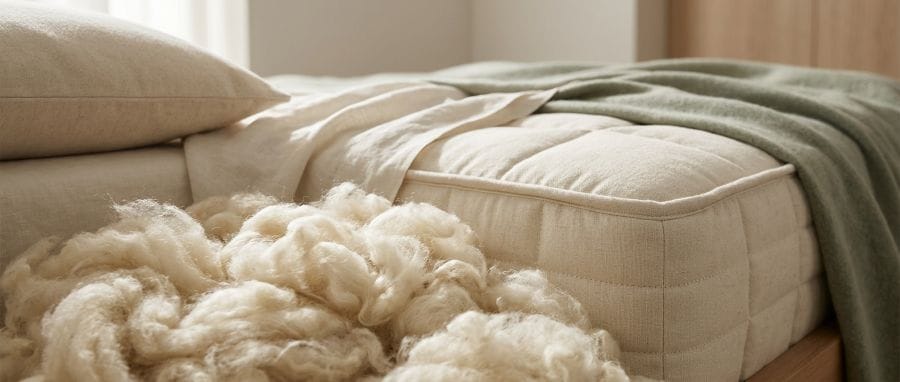
Wool has been used for warmth and comfort for centuries, but not every wool sleep product is the same. If you consciously choose natural materials, you will quickly come across the term untreated wool. But what exactly does it mean? And why would you specifically choose untreated wool?
Untreated wool fits a sleep environment in which the natural properties of the fibre are preserved as much as possible. The fibre can naturally help regulate moisture, control temperature and support ventilation. At the same time, it is important not to look only at the word “untreated”. The quality of wool also depends on its origin, processing, cover fabric and the complete composition of the product.
What does untreated wool mean?
In the context of sleep products, untreated wool generally means that the wool has undergone as little chemical or functional processing as possible before being used in the finished product. The aim is to preserve the fibre’s natural properties as much as possible.
This does not mean the wool has undergone no processing at all. Wool must be shorn, sorted, cleaned and processed before it can become a duvet, pillow, mattress or topper. “Untreated” therefore does not literally mean that the fibre goes straight from the sheep into the product.
The relevant question is mainly which treatments have been applied afterwards. Is the wool washed without intensive after-treatment? Has the fibre been chemically treated to create certain properties? And is it clearly described what exactly the product contains?
Why choose untreated wool?
The main reason to choose untreated wool is that you are using properties the fibre already has naturally. Wool does not need to be artificially enhanced to absorb moisture or regulate warmth.
This makes wool interesting for people who want to furnish their bedroom as naturally as possible. Especially when you combine several sleep products, choosing natural materials can contribute to a calmer, less synthetic sleep environment.
Wool helps regulate moisture
One of wool’s best-known properties is its ability to absorb moisture. During the night, you lose moisture through your skin and breathing. When that moisture is not adequately dissipated, a bed can feel clammy or stuffy.
Wool can absorb some of that moisture and gradually release it back into the environment. This can help a wool sleep product feel dry and comfortable, even when you perspire somewhat during the night.
This is particularly interesting for warm sleepers. If you regularly wake up in a clammy bed, you may benefit from natural materials that handle moisture more effectively. Also read how natural fibres can help with better moisture management.
Wool regulates warmth naturally
Wool is often seen purely as a winter material, but that does the fibre a disservice. The structure of wool helps retain air and therefore supports a stable temperature around the body.
In a cold bedroom, wool can provide cosy warmth. As your body becomes warmer during the night, its moisture regulation helps maintain a less stuffy feel.
So the aim of wool is not simply to sleep “as warm as possible”. It is more about a stable sleep climate in which heat and moisture are less likely to become unbalanced.
The fibre remains breathable
Wool’s natural structure contributes to ventilation. This is important because a sleep product needs not only to retain warmth, but also to process excess heat and moisture.
That is why wool can be an interesting choice for people who quickly find a bed with many synthetic materials stuffy. It offers a natural alternative without requiring you to choose an extremely thin or cold sleep product.
Untreated wool versus heavily processed wool
Not every wool sleep product has the same material construction. During processing, wool can undergo different treatments to influence shrinkage, felting or care properties, for example.
This does not mean every treatment is undesirable. Some treatments serve a practical purpose and can improve a product’s lifespan or usability. However, if you consciously choose a sleep product that is as pure as possible, you mainly want to know which processes have actually been applied.
That is why transparency is more important than an absolute claim. A supplier who clearly states which wool is used and how it has been processed gives you more information than a product marketed simply as “100% natural”.
What is untreated wool used for?
Wool is versatile and is used in different products for natural sleep. The properties of the fibre remain broadly similar, but the effect depends on how the wool is processed and on the function of the product.
Wool in mattresses
In a natural mattress, wool can form part of the comfort or finishing layers. It mainly contributes to moisture regulation and a pleasant sleep climate.
A wool layer does not determine on its own how a mattress feels. The core and support remain at least as important. To learn more about the benefits of wool in a mattress, read wool mattress: the benefits explained.
Wool in mattress toppers
A wool mattress topper can be interesting when you want to change the feel of your existing bed without immediately buying a new mattress. Wool can add a soft, natural comfort layer and help regulate moisture and temperature.
If you want to compare different natural toppers, see wool, horsehair or natural latex: which mattress topper suits you?
Wool in duvets
Wool is also an important natural duvet filling. A wool duvet can provide warmth without completely closing off the sleep climate.
The right version depends on the season and your personal need for warmth. For example, a thin wool filling can feel very different from a heavy winter duvet.
For a broader comparison, see the complete guide to choosing a natural duvet.
Wool in pillows
Wool is also used in pillows. A wool pillow can be particularly interesting if you value natural materials and good moisture regulation around the head.
At NaturaBed, several natural pillows are also adjustable, allowing the amount of filling to be adapted to the desired height and support. For a complete overview of what to consider when choosing a pillow, read our guide to choosing a natural pillow.
Is untreated wool suitable for warm sleepers?
Wool can be particularly interesting for warm sleepers. That may sound contradictory because wool is mainly associated with warmth. The difference, however, is between retaining heat and regulating heat.
A material that only insulates but removes little moisture can feel warm and clammy. Wool combines insulation with moisture regulation. This allows the bed to remain cosy without excess moisture accumulating as quickly.
That does not automatically make wool the best choice for every warm sleeper. The complete construction of the bed remains important. A thick wool layer under a highly insulating synthetic duvet, for example, can still feel warm.
If you mainly perspire heavily at night, also see our guide to the right duvet for night sweats.
Is untreated wool better for sensitive skin?
For people who consciously want to use less processed materials, untreated wool can be attractive. The fibre is natural and does not need all kinds of functional coatings to regulate moisture.
But natural does not automatically mean hypoallergenic. Some people are sensitive to wool or find the material less pleasant directly against the skin. The cover fabric and any other materials in the product also play a role.
If you have sensitive skin, therefore look at the complete product rather than only the filling. Certifications can also help provide more insight into the material and processing.
For example, read what OEKO-TEX means for bedding and what you can expect from GOTS-certified bedding.
What should you look for when buying untreated wool?
The term “untreated” is only valuable when you know what it means. When buying, therefore, look at the following points:
- Origin: is it clear where the wool comes from?
- Processing: is it explained how the wool is cleaned and processed?
- Additives: does the product contain only natural materials or also synthetic fibres?
- Cover fabric: is the outer fabric also natural and breathable?
- Certification: are relevant certifications present and is it clear what they certify?
- Care: does the care required by the product fit how you want to use it?
Also pay attention to the exact wording. “With wool” means something different from “100% wool”, while “natural” says even less about the complete composition. The clearer the material information, the easier it is to make an informed choice.
Untreated wool and sustainable sleep
Wool fits well into a natural sleep environment because it is a renewable natural fibre. For many people, that is an important part of choosing natural sleep products.
But sustainability does not depend on the material alone. Lifespan, origin, animal welfare, processing, care and the quality of the finished product also play a role.
A sustainable sleep product is therefore not simply a product with the word “wool” on the label. It is about the complete chain and a product that can be used for a long time.
If you want to understand the broader story behind natural sleep, continue reading What is natural sleep? The complete guide.
Untreated wool: natural comfort with clear properties
The strength of untreated wool lies mainly in what the fibre can do naturally. Wool helps regulate moisture, supports temperature control and contributes to a breathable sleep climate. This makes it suitable for various sleep products, from duvets and pillows to mattresses and toppers.
However, “untreated” is no guarantee that a product is automatically better. Always look at the complete composition, how the wool has been processed and the quality of the other materials.
For those who consciously want fewer synthetic materials and more natural fibres in the bedroom, wool can be a versatile step. Not because wool feels the same to everyone, but because its properties fit well with a calm, dry and natural sleep climate.